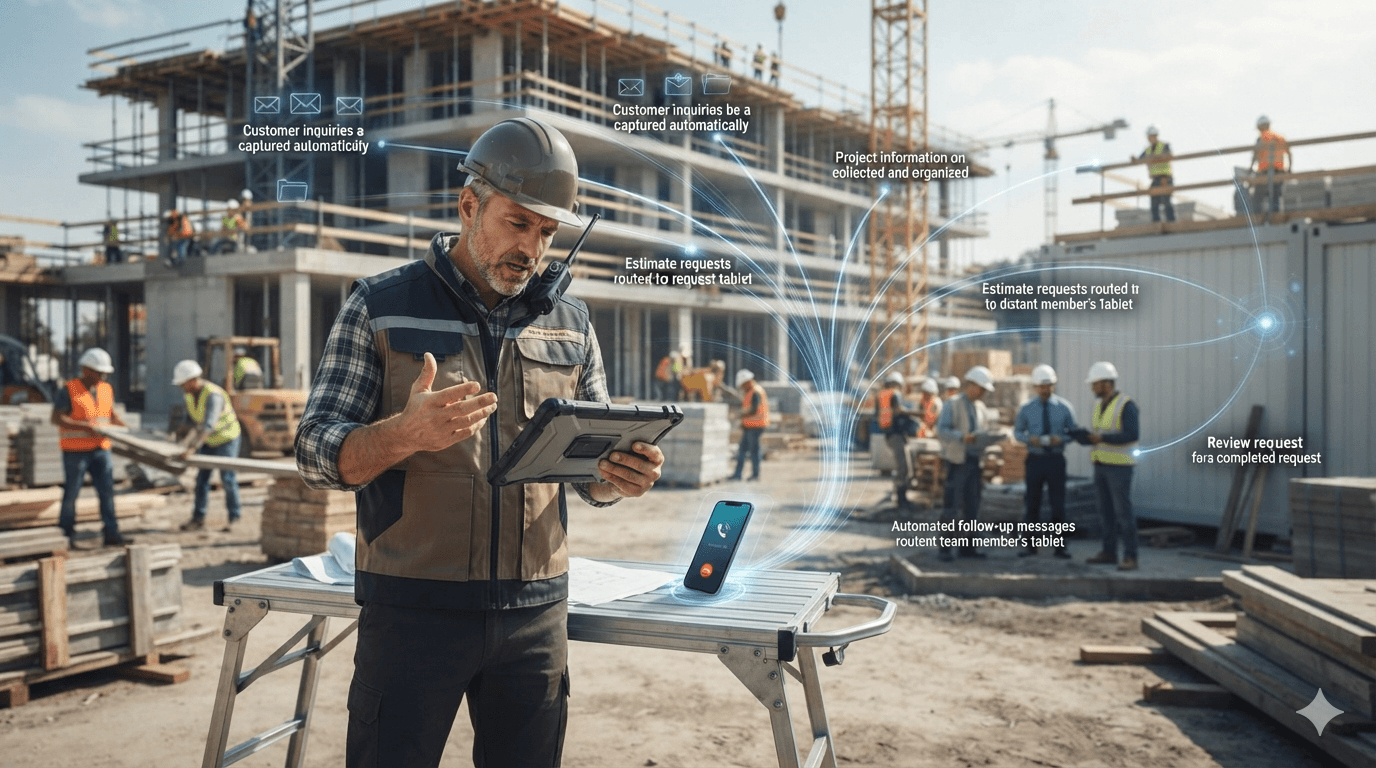
In construction, the phone rings whether or not anyone is available to answer it — and for most contractors, that means a meaningful share of new project inquiries go straight to voicemail and never get returned. Foremen and crew leads are on job sites, not sitting by a phone. Estimators are heads-down on a bid. And by the time anyone circles back to a missed call, the prospect has often already reached the next contractor on their list. AI automation exists specifically to close this gap — capturing inquiries around the clock without requiring a business to hire additional office staff.
This article covers where construction and contracting businesses lose the most opportunities, what AI automation looks like in a field-based business, and how to think about adopting it without disrupting how your crews already work.
Why Construction Businesses Are Especially Vulnerable to Missed Leads
Most service businesses lose some leads to slow response times, but construction has a few characteristics that make the problem worse than average:
Decision-makers are rarely at a desk. Owners, foremen, and estimators are moving between job sites all day, which means the person best positioned to answer a new inquiry is usually the least available to actually pick up the phone.
Projects are high-value and competitively bid. A missed inquiry for a small repair is a minor loss. A missed inquiry for a renovation or new-build project can represent tens of thousands of dollars walking to a competitor instead.
Reviews directly drive future bids. In construction more than almost any other industry, a strong base of recent Google reviews is often the deciding factor when a prospect is choosing between multiple bids — yet asking for reviews is one of the first things that falls off the to-do list when a crew is busy.
Sub and vendor coordination is constant and manual. Between subcontractors, suppliers, and vendors, a huge amount of a project manager’s time goes into email and phone coordination that doesn’t require judgment — just consistent follow-through.
What AI Automation Looks Like for a Construction Business
AI automation in this context isn’t about replacing estimators or project managers — it’s about handling the repetitive, time-sensitive tasks that currently get missed or delayed because the right person is on a job site instead of at a desk. In practice, this typically includes:
- 24/7 inbound capture. New project inquiries — by phone, text, or web form — get an immediate response and initial qualification, regardless of when they come in.
- Automated estimate intake. Instead of prospects waiting for a callback to even describe their project, AI can gather the details needed to start a preliminary estimate and route it to the right team member.
- Automated review requests. After a job wraps, a review request goes out automatically rather than depending on someone remembering to send it — which compounds over time into a stronger, more current review profile.
- Sub and vendor coordination support. Routine scheduling confirmations, material status checks, and follow-ups can be automated, freeing project managers to spend their time on the coordination that actually requires judgment calls.
The Real Cost of a Missed Inquiry in Construction
It’s worth being specific about why this matters financially, because “better lead response” can sound like a minor operational improvement rather than what it actually is. Two dynamics drive most of the impact:
After-hours and weekend capture. Homeowners researching a renovation, and businesses researching a build-out, frequently do that research in the evenings or on weekends — exactly when a typical contractor’s office is closed. Every inquiry that comes in during those windows and gets an immediate response, instead of hitting voicemail, is a real shot at a bid the business would otherwise have missed entirely.
Speed-to-lead on competitive bids. When a prospect requests quotes from multiple contractors, response speed is consistently one of the strongest predictors of who gets the job — often outweighing factors like price, once multiple contractors are in similar ranges. Responding in seconds rather than the next business day materially changes the odds of winning that bid.
Addressing the Concerns Contractors Actually Have
“I don’t want a robotic voicemail system — I want it to feel like calling my business.” A well-configured AI phone assistant is trained specifically on your business’s services, service area, and typical project types, and is built to sound like a natural conversation rather than an automated menu. For anything outside its scope, it should hand off to a person rather than guess.
“Will it actually understand construction-specific requests, or just generic scheduling?” This depends heavily on how it’s configured. A generic, off-the-shelf chatbot won’t understand the difference between a kitchen remodel inquiry and an emergency repair request. A properly trained assistant is set up around your specific services and can route or prioritize accordingly.
“We already ask for reviews — we just don’t do it consistently.” This is exactly the kind of task automation is best suited for: not something that requires judgment, but something that requires consistency that’s hard to maintain manually when a crew is stretched thin.
Data and Contract Information Deserve Protection Too
Construction businesses handle more sensitive information than it might seem at first glance — client contracts, project bids, subcontractor agreements, and sometimes payment or financing details. As AI tools get adopted for scheduling and lead capture, it’s worth making sure that data stays inside the business’s own environment rather than getting pasted into free, consumer AI tools by someone trying to move quickly on a proposal or contract review. A deployment that captures leads well but leaks contract data through unmonitored tools isn’t a complete solution — both pieces need to be addressed together.
How to Tell Where the Opportunity Is Biggest
A few direct questions can help identify where automation would make the most difference for a specific construction or contracting business:
- How many inbound calls or web inquiries go unanswered during a typical week, particularly evenings and weekends?
- How long does it currently take to get a preliminary estimate back to a prospect after they first reach out?
- What percentage of completed jobs actually result in a review request being sent, and how consistently?
- How much of a project manager’s week goes toward routine sub and vendor coordination that doesn’t require real decision-making?
Businesses that find meaningful gaps in more than one of these areas tend to see the clearest, fastest return from automation.
A Phased Approach That Doesn’t Disrupt the Field
The goal isn’t to overhaul how your crews work — it’s to close the gaps that already exist between the office and the field. A sensible starting point is AI automation for business focused specifically on inbound call and lead capture, since that tends to produce the fastest, most measurable results, with review automation and sub/vendor coordination layered in afterward as the business gets comfortable with the system.
Frequently Asked Questions
How fast can a construction business see results from AI automation? Most businesses see measurable improvements — more captured inquiries, faster estimate turnaround — within the first month, since inbound call capture is typically the first thing deployed.
Will an AI assistant know the difference between an emergency repair and a standard project inquiry? When properly configured around your specific services, yes — it can prioritize and route inquiries differently based on urgency and project type rather than treating every call the same way.
Does this require replacing our current phone system or scheduling software? No. A well-built deployment integrates with the phone system and scheduling tools already in use rather than requiring a full replacement.
Can AI automation help us get more Google reviews? Yes — by automatically sending review requests after job completion rather than relying on someone to remember, review volume and consistency typically improve over time.
Is this only worth it for larger construction companies? Smaller contracting businesses often see a proportionally larger benefit, since a single missed high-value inquiry represents a bigger share of their available project pipeline.
Vertascale, based in Gainesville, Georgia, helps construction and contracting businesses capture more leads and automate routine coordination without adding office headcount.
Get in Touch for a Tailored Solution
At Vertascale, we're more than just an IT provider — we're your partner in security and growth. We'll take care of your IT and cybersecurity so you can focus on your business.
Contact Us Call 470-778-0705